The Year I wasn't WEIRD
WEIRD: an acronym coined in 2008 to describe a bias in psychology where studies were conducted with participants from "WEIRD" ("Western, Educated, Industrialized, Rich, and Democratic") societies and then generalised to the rest of the world.
Also weird: a word affectionately used by others to describe me as various times in my life.
We all have events and experiences that create strong, core parts of our identity. Experiences that set up the stories we tell ourselves about how the world works. I have an unexpected one, I spent a year living in a rural Thai community in the 1990s and, unsurprisingly, it changed my life.
That part is obvious, of course a year living abroad is life changing. But for most people who look like me (white skinned, female) that time abroad is often as a visitor to a place and culture, either as an expat or as a tourist. Both of which are interesting and valuable experiences, but one in which your existing worldview isn't likely to be substantially re-shaped.
For me, I wasn't a visitor. I was, eventually, a Thai person.
How did this happen?
Courtesy of a high school exchange in the days before email and the internet. This meant I had no contact with my Australian life beyond the occasional letter, and could immerse into the life of my host family, my high school and my community.
And, as a perennially curious individual, who likes other people and with a brain built for puzzle solving and fitting in, I deeply immersed.
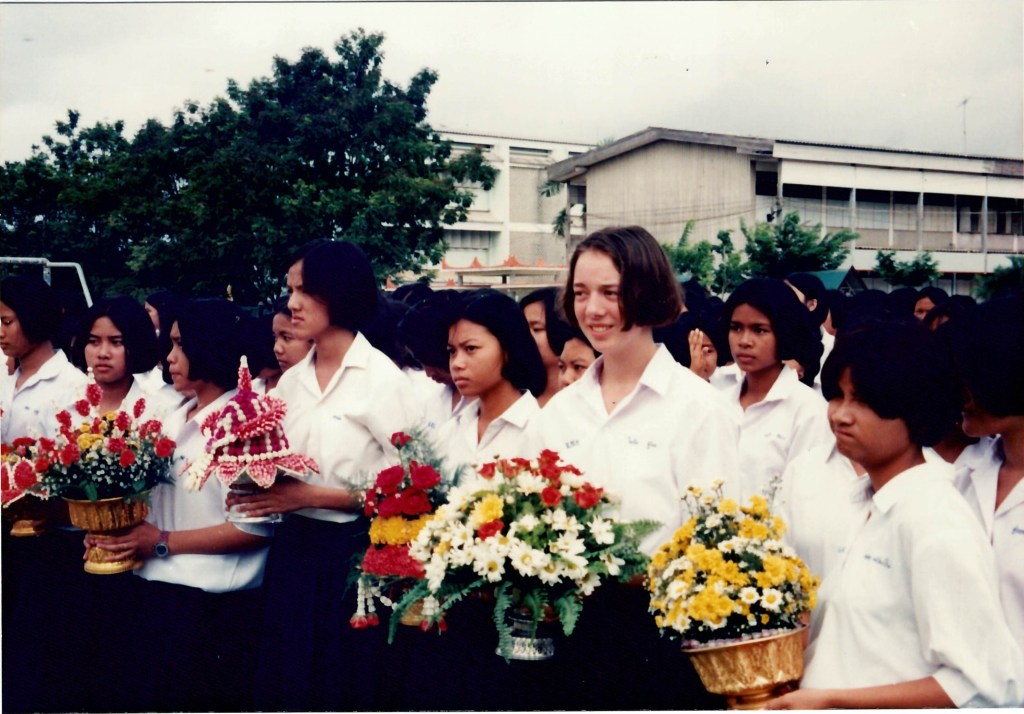
A ceremony at my High School to pay respect to our teachers.
By 6 months I was translating for other exchange students. Eventually I was dreaming in Thai and English was strange. I adopted the customs and mannerisms so well that I would often be asked if I was luuk-krung (biracial) since people like me didn't live in Thai villages speaking without an accent. When I went to pay my respects at a royal funeral with a friend all the Thai people around me leapt to my defence when one of the ushers thought I was a lost tourist - "Let her in, shes' Thai".
It also helped that my Thai community was very generous, inclusive and accepting. Oh, and that they had a lot of patience and good humour while I was fumbling my way through the first two months of language acquisition.
Cultures aren't just language and customs though. They are attitudes and relationships and stories about how things are supposed to be, what it means to live a good life and to be a good person.
To this day parts of my worldview are very much grounded in the culture I absorbed that year, and I remain very grateful that I had that chance.
Why this post now though?
As I write this I am on a plane going 'home'. For the first time in 3 decades I am about to spend quality time with my family and my community. For the last few weeks, as this trip has gotten closer and closer my brain has been switching itself back to Thai-mode.
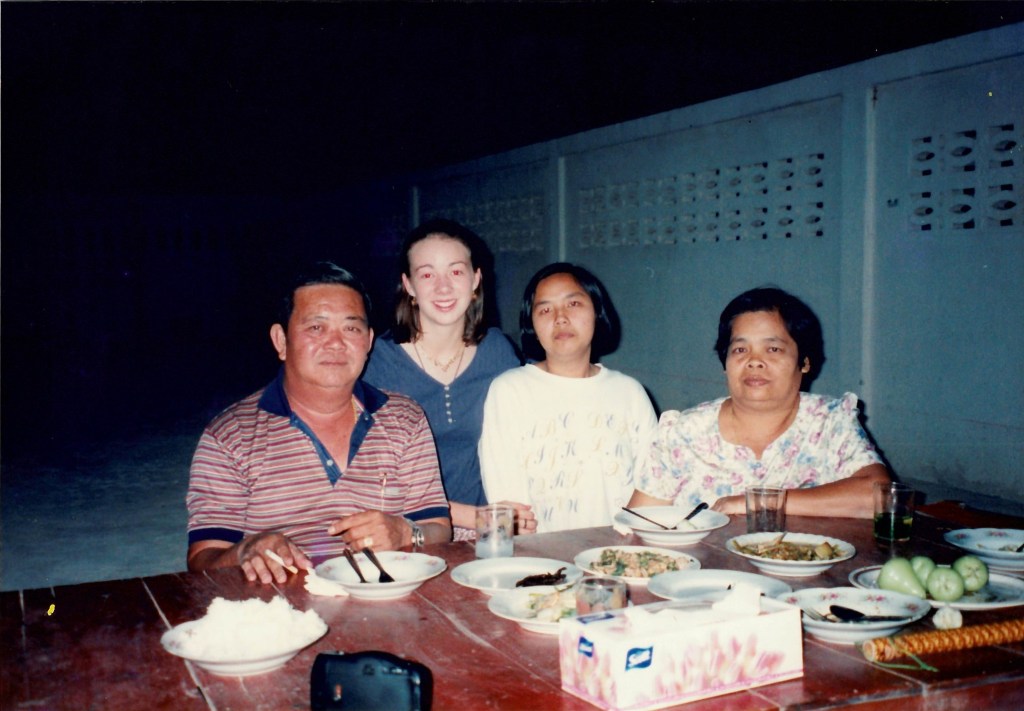
My family. Trust me, they smile a lot, just not in photos.
Also, I set this blog up in time to use it to record some of the reflections that will be generated by this trip, so this post is somewhat foundational.
Not WEIRD
When we left on exchange we were drilled on the phrase "It's not right, it's not wrong, it's just different". A beautiful phrase to take through life. An invitation to pause and try to understand what is happening.
An example - in the 90s many Thai households would have a roll of toilet paper on the dinner table to be used as a paper towel equivalent. The first few times I saw it I had to check in with myself: "It's just paper, it's never been near a toilet. So this is not wrong, just different".
But this is not a full-on sociological post on the differences between Thai and Australian cultures across three decades - there's a whole book in that.
Coming back to the title, I want to introduce you to a really useful concept - that it's easy to forget that societal values and practices aren't universal, and the acronym WEIRD ("Western, Educated, Industrialized, Rich, and Democratic") is a playful way to question this.
"Is that a universal statement, or is it only true in WEIRD societies?"
I especially enjoy that it points out that a lot of the world isn't WEIRD at the moment and hasn't been WEIRD for most of human history.
In particular I want to examine the W and I. In our culture it's generally assumed that there's a trajectory of westernised = good and industrialised = good. But, what if it isn't? By that I mean as a singular trajectory. Having lived in a non-western, non-industrialised society I can see all sorts of things we've lost, such as community, being able to rest and slow down, and a more organic aesthetic.
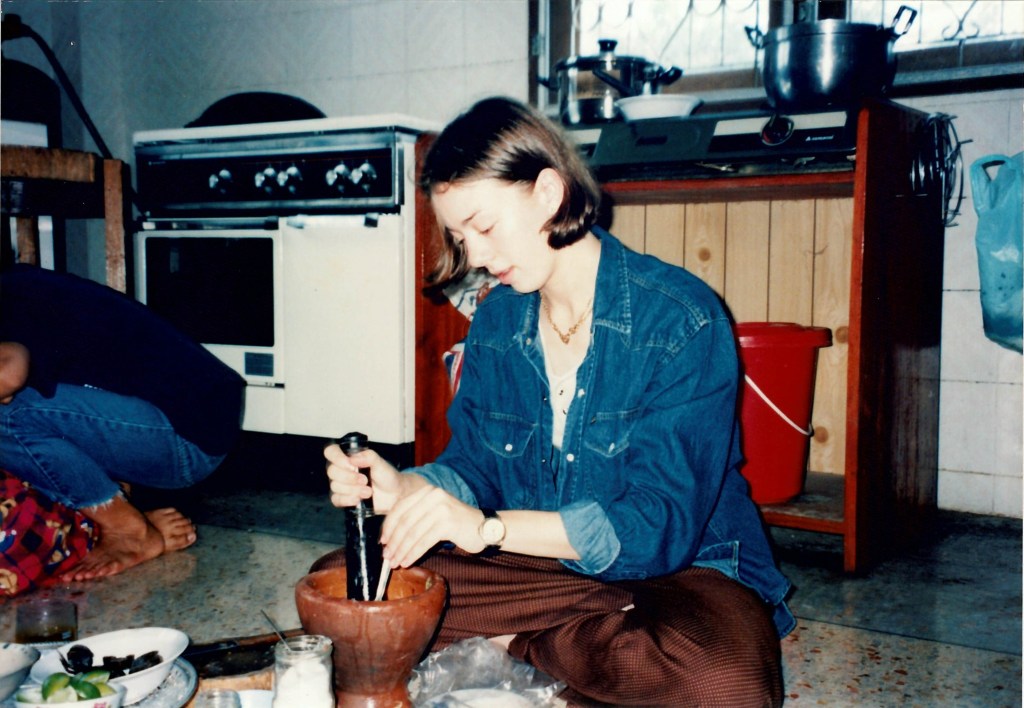
My birthday party - sitting in the kitchen making somtum for my friends
I've found that once you see a few things that are "not right, not wrong, just different", you start to question other core beliefs. Such as "Why is economic efficiency so important? Especially if it is at the expense of quality time with those we love" or "when does it become OK to have homeless people and to assume a certain level of unemployment was necessary for our economy to run?" or "why is the metaphor of humans or systems as a machine so central to our worldview and is that a good thing?" and finally "why are we so suspicious of other people so that we close off our hearts and our generosity".
I think a fair bit about what a Good Life looks like, and so far my conclusion is that the pinnacle of a WEIRD society just isn't it, and its why I'm eternally grateful to have had a year immersed in one of the alternatives so I can think constructively about my native culture and do my part to prod it towards being kinder, more chilled out and more socially generous. I genuinely think these elements will make us all happier overall.